Posted on January 30, 2025
Hack #1
When we play with dolls, we assume it’s a one-way interaction: we project stories onto dolls, give them emotions, and move them through imaginary worlds. But what if the doll could react? What if, instead of being a passive object, it was an active participant?
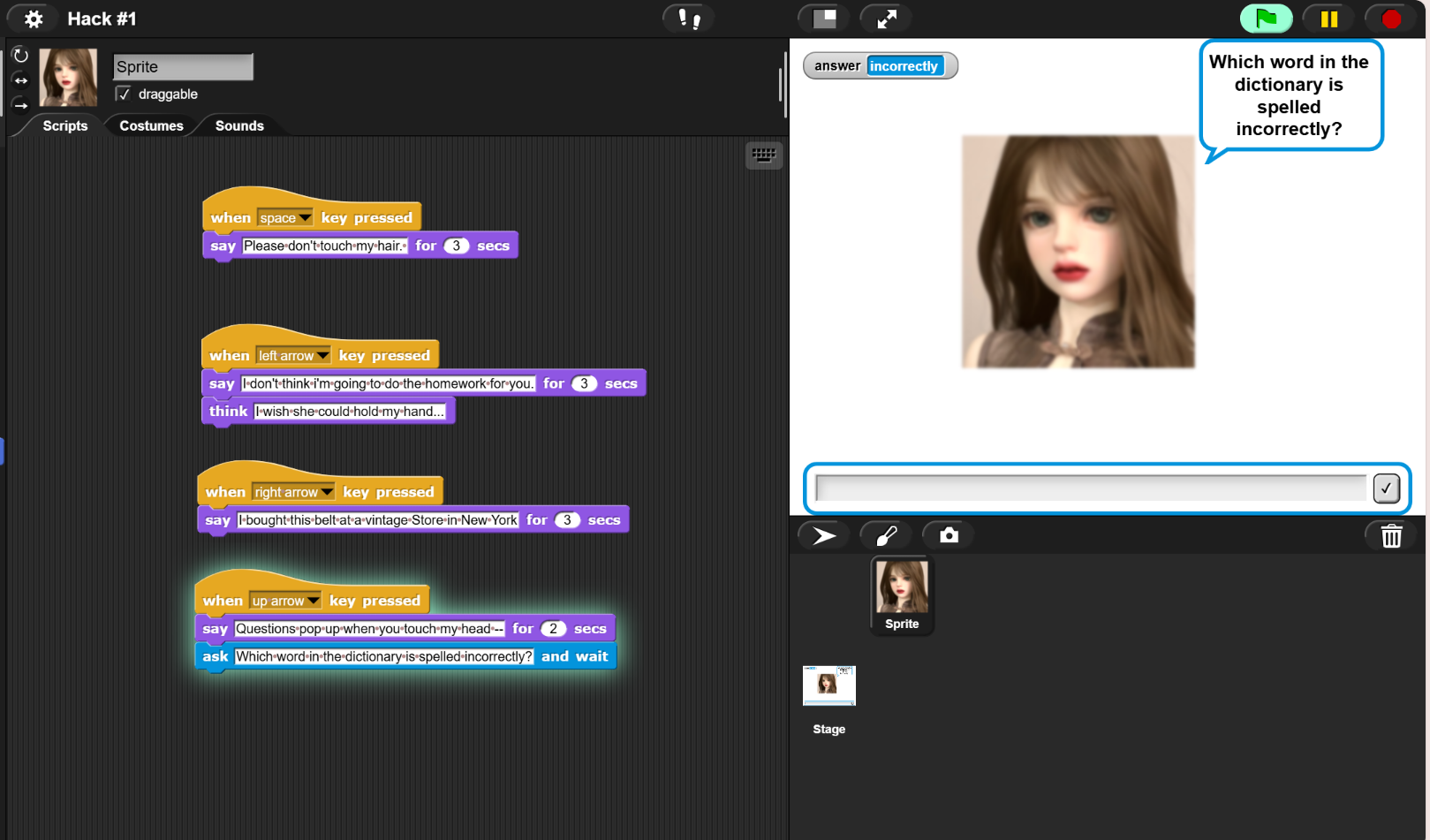
This project explores the boundaries between play, subject and object. I connected different parts of the doll to Makey Makey. When these parts are touched, a pre-programmed response in Snap is triggered, making it seem as if the doll is reacting to human touch.
The responses may seem mundane – simple, everyday phrases – but the behavior the doll responds to upends our expectations. It is no longer just a toy, but an interactive subject.
Caillois categorized games into four types, one of which—Mimicry (roleplay and simulation)—is at the heart of this work. Typically, mimicry involves the human assuming a role, but here, the doll itself participates in mimicry, mimicking the act of conversation, even though its responses are pre-programmed. All the conversations of this doll are designed to be more colloquial, which can bring people a more intimate feeling. The parts I chose were her hair, belt, fingertips, and top of her head, Each meant to create a specific personality of the doll. When touching the belt, she would introduce the clue where she bought it, providing her life experience; when you touch the top of her head, she will ask you an interesting question, which represents her own thoughts and the sense of humor. And when you touch her finger, she’ll say “I won’t do the homework for you” but also hope she could hold your hand. These settings, which incorporate fragments of life experiences and seemingly autonomous emotional responses, make her feel more real and blur the traditional boundaries of Mimicry. Typically, in Mimicry-based play, the player assumes a role and projects life onto an object. Here, however, the doll itself mimics the act of engagement, reversing the expected dynamics of play. Normally, dolls are completely manipulable toys, and their “existence” depends on the player’s imagination. However, in my project, the doll does not just react—it initiates engagement, leading the player into unexpected interactions. The traditional power dynamic between player and object is reversed: is the doll still a toy, or has it become the one directing the play. This interactive system also serves as a metaphor for the relationship between humans and objects. When an object can “speak,” does it remain merely an object? Huizinga believes that play is not just entertainment, but an act of giving meaning to the world. In this project, the interaction between people and dolls creates a miniature magic circle – a boundary space where roles are reversed and the rules of the game are rewritten. However, in my project, the doll does not just react—it initiates engagement, leading the player into unexpected interactions. The traditional power dynamic between player and object is reversed: is the doll still a toy, or has it become the one directing the play? The doll, once an object of manipulation, has now become a seemingly autonomous entity that engages the player rather than being toyed with.
Beyond the realm of play, this project also questions the way we relate to technology and inanimate objects. We live in an era where AI chatbots, smart assistants, and interactive devices blur the line between human and non-human communication. When an object responds to us, we instinctively assign it some degree of agency. If a simple programmed response is enough to make us question whether an object has agency, what does that say about our interactions with AI, with technology, and even with each other? If play is about rewriting rules, then perhaps the greatest rule to be rewritten is what it means to be ‘alive.’