Posted on March 5, 2025
Hack #3
In Design, Anne Balsamo says that creativity is shaped by culture. Learning to be “creative” means learning what creativity looks like in a specific field. In art, it’s about new forms of aesthetic expression. In science, it’s about proving hypotheses in elegant ways. No matter the field, creativity is always tied to its content. This idea inspired my Hack. If we are going to deconstruct software, why not do the opposite of what it was designed for? In daily life, productivity tools often distract us when we need to focus. It’s like kids doodling in the corners of their textbooks instead of paying attention. But what if we flipped that? What if we worked when we were supposed to be playing? That completely goes against the purpose of a game, but for this Hack, it makes perfect sense.
When people play games, time seems to pass quickly. This is especially true when a game has its own time system and lets players create their own world, making the real world feel irrelevant. Minecraft is a perfect example. As an open-ended sandbox game, it is designed to give players a virtual world separate from reality. The game offers powerful features that let players do almost anything. Its day-night cycle creates an immersive experience. These same features allowed me to build an electronic clock inside the game—one that looks and functions exactly like a real-world clock. This clock accurately tracks real-time, breaking Minecraft‘s virtual world in both time and space. My Hack deconstructs Minecraft‘s cultural context. It turns the game from an immersive escape into a reminder of reality, which shifts challenges the very meaning of creativity.
The clock I built is accurate to the second, providing a more direct and realistic reflection of time passing. Time itself is a human construct, tied to productivity. No one checks the time while doing something important in a game. However, to maintain its internal logic and simulate the efficiency of farming and daily life, Minecraft has its own time system. A clock that follows real-world time disrupts this system, creating a clash between reality and the virtual world. Minecraft gives players the freedom to create, but that creativity is still bound by the game’s rules. By bringing real-world time into the game, I create a conflict between in-game creativity and real-world logic, challenging the idea of “creativity within games.”
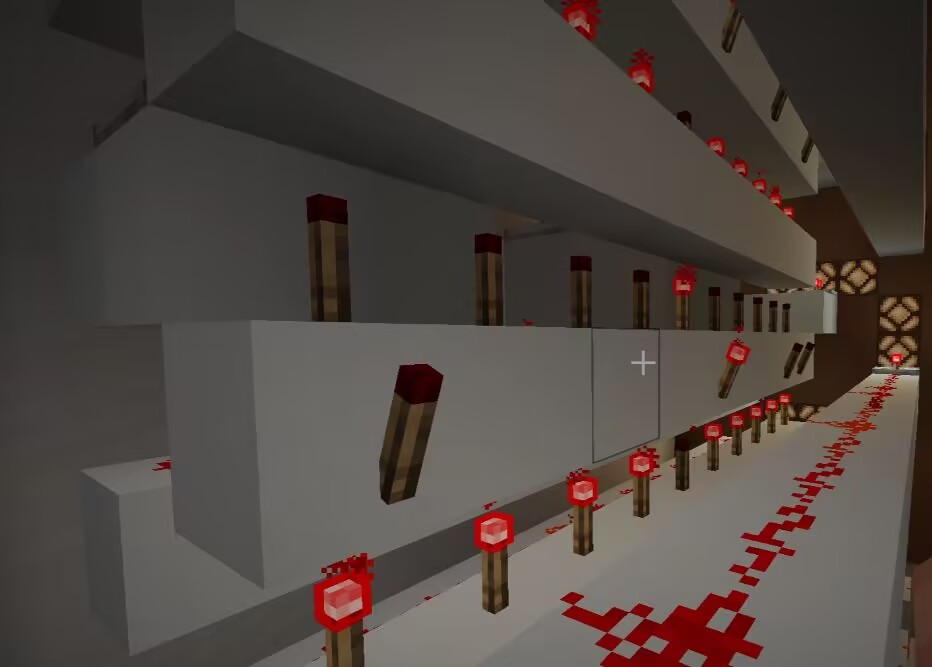
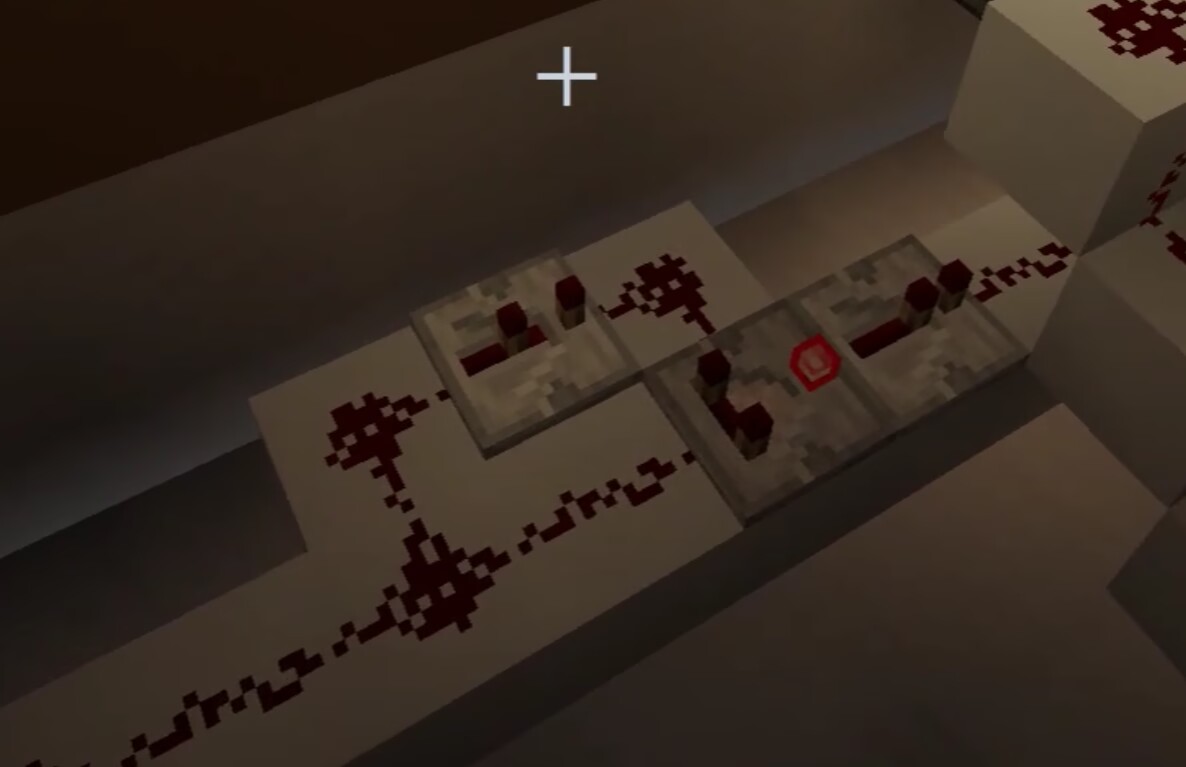
Obviously, the developers of Minecraft never intended for players to build a clock in the game, so implementing this idea is technically complex. The most important tool used in this hack is the Redstone circuit. Redstone is a circuit system in Minecraft used to create various automated devices. It functions similarly to real-world circuits, transmitting signals, triggering mechanisms, and building complex machines. After constructing the clock’s display screen using quartz blocks and display blocks, I used Redstone Dust as wiring to connect the display blocks to a Redstone Torch that provides the signal. When closely examine a real electronic clock, you’ll notice that the display numbers are made up of seven short lines. I recreated this by making seven independently controllable lines. Then, I used Redstone Dust and Redstone Torches to input the numbers 0-9. By using Redstone Repeaters, I lit up the corresponding lines from the seven segments I just created, making the correct numbers appear on the screen. This made me realize once again how Minecraft’s design is deeply committed to “de-realization” and building its own virtual world. Even something as simple as wiring, which exists in the real world, is also given a different name in the game: Redstone. Next, I needed to make it change every second. In Minecraft Java Edition, the game’s tick speed is 20 ticks per second. To achieve this, I used a Redstone Comparator in subtraction mode to create a pulse with a 1-tick cycle, and then extended it using a repeater. Since Redstone signals travel upward, the Redstone closer to the bottom receives the signal first and light up the displays earlier.
To solve this issue, I manually placed repeaters in the lower Redstone circuits to introduce a delay, ensuring that the displays at both the top and bottom would light up simultaneously. This highlights the contrast between Minecraft’s virtual world and reality. In the real world, signal delays are rarely noticeable like this. Using repeaters to eliminate the delay helped blur the boundary between the game and reality once again. Not only is the clock itself a disruption of the virtual world, but the process of creating it also marks the gradual intrusion of real-world logic into the more abstract virtual space. At this point, I just duplicated the same setup five times. In real life, it’s impossible to repeat the same task over and over. While in the game, it can be done quickly with the right functions. This difference between the real world outside the screen and the in-game experience got me thinking about different dimensions of space. In some sci-fi stories, higher-dimensional civilizations can do things that lower-dimensional ones can’t. Similarly, players have the “key” to the game, allowing them to manipulate the game’s mechanics easily. If the villagers in Minecraft were watching this, they’d probably be confused by the blocks appearing out of nowhere. They wouldn’t understand that the clock I built is recording something. If we think of ourselves, controlling the computer, as higher-dimensional beings and Minecraft’s world as a lower-dimensional one, how do we define what’s real and what’s virtual?
When I was younger, every time I play Minecraft I would get lost in the world I built until real-world time forced me to stop. Now, I’ve let Minecraft remind me of time, and it makes me wonder—am I controlling the game, or is the game influencing my reality? While I was building this Hack in Minecraft, I suddenly realized I had no idea how much time had passed in the real world. Essentially, by bringing real time into the game, I wanted to turn Minecraft into a “de-gamified” experience. However, as I tried to bring the game back to reality and weaken its gaming nature, Minecraft, as a simulation of reality, was already reshaping my perception of the real world. The difference is that when I use Minecraft not for entertainment, but to complete an assignment, the game’s nature is already changed. The game becomes a tool for completing my work. In that moment, the game is reality to me.