Posted on February 19, 2025
Hack #2
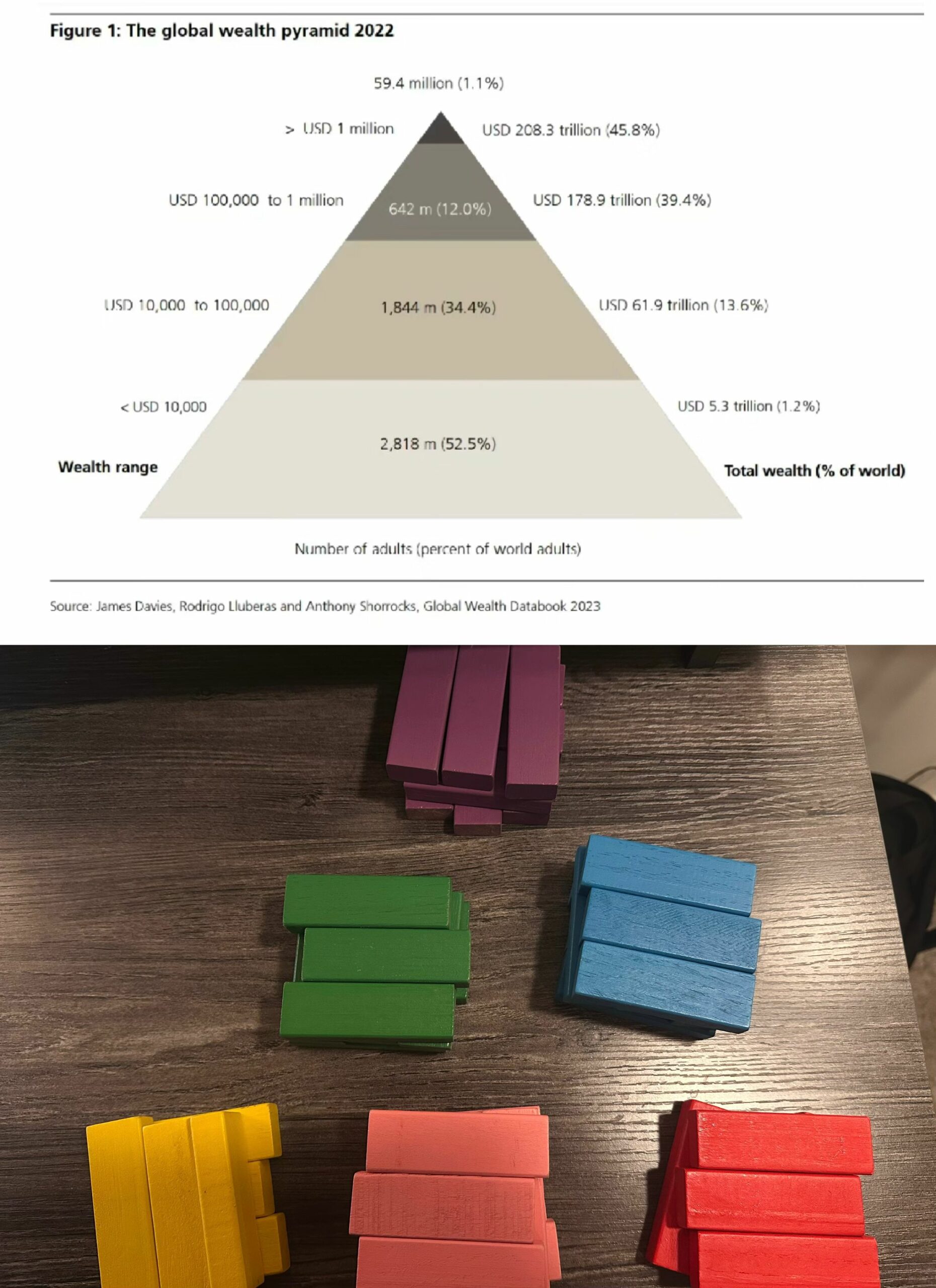
In our real world, society is like a precisely built tower, where countless individuals at each level support the stable operation of the levels above them. “Class Jenga” uses this metaphor as its foundation. By modifying the traditional Jenga rules, it allows players experience power imbalance, class immobility, labor exploitation, and the fragility of social structures during gameplay. This work draws from Mary Flanagan’s Critical Play theory, aiming to help players feel the invisible rules of society through seemingly simple game decisions, and understand how these rules shape people’s lives, limit their choices, and ultimately affect how the whole society works.
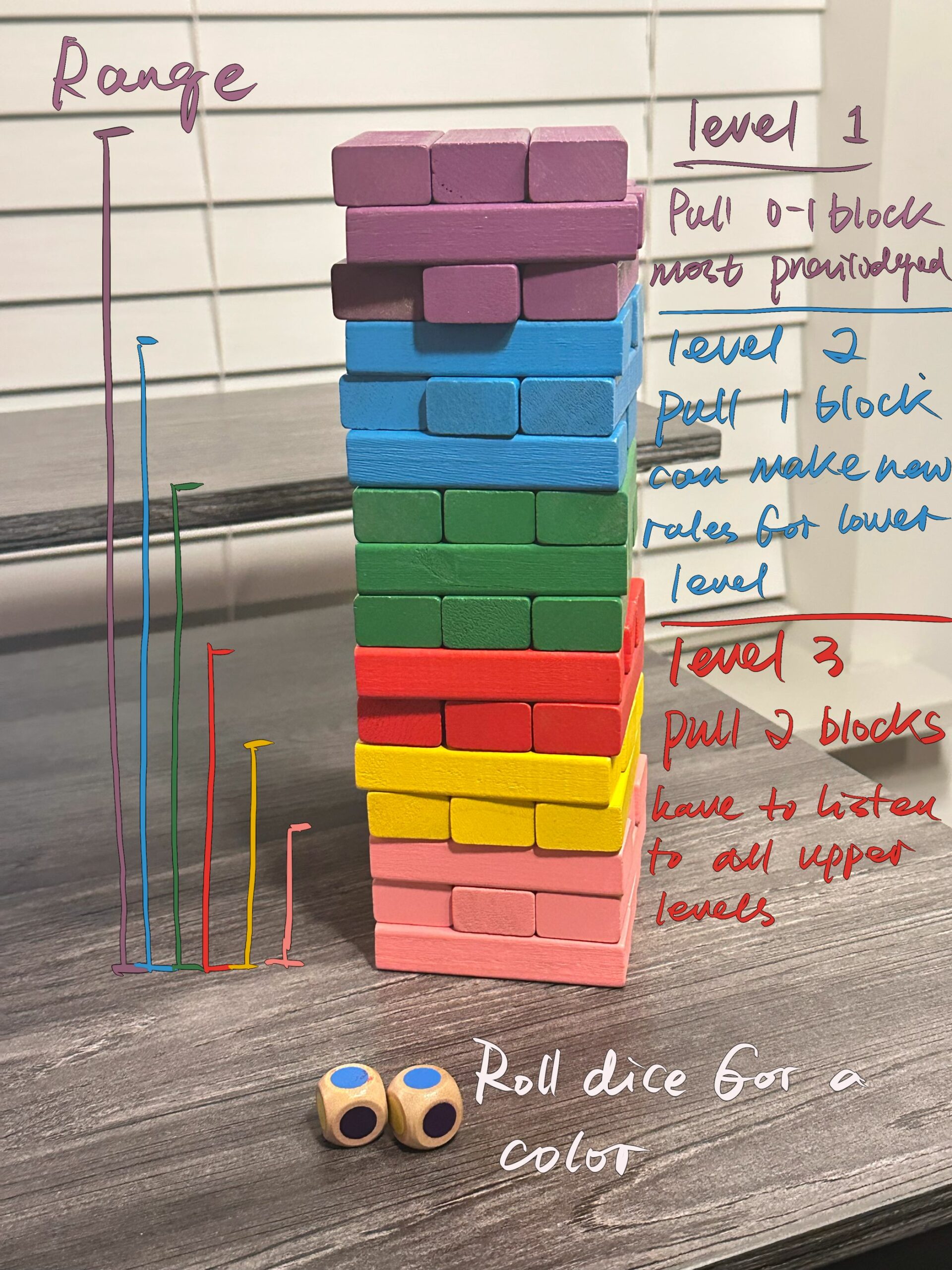
The main component of this game is a Jenga set that includes blocks in purple, blue, green, yellow, pink, and red colors. Purple represents the wealthiest people, blue and green represent the middle class, while yellow, pink, and red represent the lower classes. Purple players pull one block per game or none, green and blue players pull one block per game, and the bottom yellow, pink, and red players pull two blocks per game. Players of higher social classes can pull blocks from their own level and any levels below them, while players of lower classes cannot pull blocks from levels above their own. And if one person lets the tower fall, everyone else in his class loses.
Unlike traditional Jenga where everyone plays equally, players are randomly assigned to different classes at the start of the game. Players in lower classes bear more responsibility and face more restrictions while having fewer choices. Apparently, since Jenga’s game rules are “whoever pulls the blocks that cause the tower to fall loses”, the lowest yellow-pink-red player is more likely to lose the game, while the purple player has almost nothing to worry about. This creates a clear parallel with real society: capital is concentrated in the hands of very few people. They can lead a rich life, while workers in the lower class must not only work hard to maintain their own livelihood but also support the normal operation of the entire social system. The most striking demonstration of social power imbalance is shown through the power to make rules in the game. Players in higher classes can not only choose to pull fewer blocks but can also freely modify the rules, forcing lower-class players to take on extra tasks such as “pink and red players must pull an additional block.” This symbolizes how the wealthy continuously adjust the rules of the game through lobbying, legislation, and policy influence to secure their existing benefits while making survival conditions more harsh for the lower classes. Lower-class workers usually cannot decide their own fate that their way of life is restricted by established systems that often serve the interests of the upper classes. Even more ironically, in the game mechanics, higher-class players can keep making new oppressive rules without having to bear any actual labor burden themselves. When facing increasing labor burdens, lower-class players can choose to unite and go on strike. If all lower-class players reach a consensus, the new rules made by upper classes become invalid. However, this mechanism is extremely difficult to achieve because of the “scab” mechanism in the game – each round secretly selects one lower-class player and gives them a chance to “betray.” If they choose to betray the strike action, they can gain immunity in the next round and temporarily avoid pulling blocks. Players must make choices under this dilemma: should they betray their companions for short-term personal benefit, or persist in collective action to fight the oppression? However, even if betrayers gain temporary immunity, they can still be overruled by higher-class players and return to their exploited state. This gameplay reveals the limitations of individualism under capitalism. Capitalists may give benefits to individual workers, but the class as a whole remains unable to change its situation. These game rules directly correspond to the dilemmas faced by real-world labor movements: capitalists often divide worker groups by offering short-term benefits (like bonuses or promotion opportunities) to undermine solidarity and make strikes unsuccessful. Meanwhile, capitalists always retain the final authority even if individual workers are bought off, the overall social rules won’t truly change. The strike mechanism lets players experience the conflict between individual and collective interests during gameplay, revealing why it’s so difficult for the lower classes to form truly effective resistance.
In traditional Jenga, the player who makes the tower fall is usually seen as the loser. While in “Class Jenga,” this logic is completely reversed. When the tower falls, the winner isn’t the higher-class players who avoided labor and made rules, but rather the player who pulled the most blocks and bore the heaviest labor burden. This fact isn’t revealed until the game ends, so during gameplay, players will still assume the rules are like traditional Jenga and try hard to avoid being the one who makes the tower fall, which motivates them to pull fewer blocks. This victory condition carries strong irony by revealing the true pillars of real society are the workers, not the capitalists. Capitalists don’t create actual goods and services; they accumulate wealth by manipulating market rules, monopolizing resources, and exploiting labor. In the real world, we often think “success” means having wealth, power, and status, but in fact, society’s normal functioning depends on millions of ordinary workers. Without workers, production lines cannot run; Without deliverymen, a city’s logistics system would collapse; If there were no farmers, people would not have access to food. It is not bankers, investors, or entrepreneurs who truly support society, but the people who work every day. Yet workers are in the most precarious and insecure positions. Their labor is the cornerstone of the functioning of society. They are the first to be exploited, the easiest to replace, and the least recognized. In “Class Jenga”, the stability of the tower relies on the building blocks of the lower class instead of the upper class. This setting clearly expresses the core contradiction of the real society: the more wealth, the less labor; The more work, the lower the social status. Workers bear the burden of the system, but the ultimate social recognition belongs to those who control capital. Once the bottom can no longer be supported, the entire social system will collapse.
The game is not just a physical challenge, it is a metaphorical experiment in social structures. It uses Jenga as a game carrier to let players personally experience the social injustice, the powerlessness of labor exploitation, the complexity of the labor movement, and the reality that capital controls the society. Each game segment reflects a different aspect of real society: class division reflects the solidification of wealth and social inequality; rulemaking power reveals how capital manipulates policy to keep those at the bottom exploited. At the end of the game, the player is not only victorious through strategy, but their more important achievement is to think: if the real society is also a Jenga tower, then our class determines our fate. Is the predicament of those at the bottom really unchangeable? If the tower eventually collapses, have we already seen the inevitable outcome of social injustice? In this way, Class Jenga is not just a game, it is a critical narrative, a visual representation of the unjust structure of the present society, and a meditation on the future of society.